Sunday, September 27, 2020

The Ninth UltraVan

There are no clues in the historical record relating any known coach to build #7 or build #8. We are left to draw the tenuous conclusion that these are the two missing Travalons that have never been identified.

For coach #9 however, we find a single clue in The Historical Record - the nascent coach registry published in January 1987 by Ultra Historian Louis Griggs. Louis lists the owners of coach #009 as: Venable of CA, Farnsworth of Boise ID, and Barr Musser of Salt Lake City UT.

William R. Venable of San Carlos CA is listed in Dave Peterson's notes. Farnsworth is not mentioned in any other available records; presumably he was identified as the previous owner by Barr Musser. Barr and Thelma Musser were UVMCC members from 1975 to 1992. They initially registered as owners of coach #163, then 10 years later switched to #102. But they only ever owned one coach: serial #163102 - usually known as UltraVan #163, or rarely as Travalon #102, or more simply as The Green Machine.

The Green Machine is 24 feet long (162 inch wheelbase) with stepvan windshields, Chevy pickup bumpers, Econoline headlights, Prescolite taillight pods, and ornamental dually wheels. And although it currently operates with 14-inch wheels, the earliest photos show the same turbine 13-inch wheelcovers used on all Oakland-built UltraVans.

Prescolite omitted the tow hitches on #163, and introduced a number of significant upgrades.

This 1963 Travalon uses the upgraded 1964 model year Corvair rear suspension, with its transverse leaf spring "camber compensator". The newly stroked 1964 engine was also used (110 HP), along with a 3:89 geared axle.

The coach features a large air vent behind the passenger rear wheel and a smaller vent on the driver side, to duct cooling air directly into the engine compartment. Although this arrangement seems familiar to most UltraVanners, it was actually not incorporated into production until after #235. For those early coaches, cooling air is drawn from below the coach around the unsealed perimeter of the engine.

Alert readers may have noticed that #6 also was equipped with external cooling air vents, though they are located further aft. #101, #200, #103, #4, & #63104 were not.

Out front, Prescolite integrated the headlight fairings, the bumper brackets, and the previously separate aluminum and fiberglass body sections into two large molded sections - one for each corner. They also altered the front slider windows, raising the bottom edge to align with the rear windows along the beltline.

Inside, Custom Trim installed their usual upholstered walls and ceiling, and added a Pullman-style folding sink to the bathroom for more comfortable showering.

Perhaps most significantly, Prescolite installed three removable fiberglass holding tanks under the floor of the coach (fuel, water, & waste). Earlier coaches created tankage by simply sealing up portions of the riveted aluminum floor structure, which eventually resulted in extremely difficult to repair corrosion problems and leaks.

To create space for the removable tanks, Prescolite used extruded rocker beams with cast aluminum fittings connecting to front and rear cross beams. The cast corner fittings cleverly incorporate sockets for removable jacking points.

With its two-tone lime & forest green paint scheme and elaborate white striping, the Green Machine definitely stands out in a crowd. Barr & Thelma attended UltraRallies throughout 1975-1979, including Robert's Creek British Columbia, Lake Cahuilla CA, Russian River (Guerneville) CA, and Walla Walla WA. In 1988 Barr listed the coach for sale in the Whales on Wheels newsletter, but he wasn't able to find a buyer. Finally in 1992 he donated the coach to Jim Craig, even paying to fly him to Salt Lake so he could fetch it back to Joshua Tree.

Jim soon realized why the coach hadn't sold, but with the help of local Corvairist Rudy Schmidt he was able to replace 4 bad lifters, 6 bent pushrods, the #3 rod & piston, both heads, gaskets, fuel pump, generator, and U-joint seals. They installed two rebuilt carburetors, performed a major tune-up, and bypassed the fuel feed into two five-gallon jerry cans. The 650 mile drive home to Joshua Tree was uneventful.

Jim and his wife Marlene had owned at least seven other UltraVans prior to the Green Machine, but they were quickly smitten and decided it would become their "final" UltraVan. Back in Barr's day #163 had an UltraVan emblem on the front, and a front mounted spare tire emblazoned "Barr-Thel's Happy Daze". Jim removed these and today the Green Machine has a single Travalon emblem on the trunk lid. Jim also replaced the damaged body panel under the driver's window (note the slightly darker paint), rebuilt the entire aluminum rear support structure, installed a rebuilt 140 HP engine and Corvair engine seals, changed to a 3:55 geared axle, upgraded the house and engine wiring, installed a retractible awning, and added a third roof vent in the bedroom area.

Jim & Marlene greatly enjoyed their time with the Green Machine; to this day Jim calls it the best handling UltraVan he ever drove (except for the brakes). However in 1999 the last UltraVan ever completed became available and well, Jim couldn't resist. He sold #163 to his son Robert to finance the purchase of #604. Robert Craig sold his previous coach #285 and moved the personalized "FRMMARS" plates to #163, but then he sold #163 on to Todd Koons of Sausalito CA for use in a nationwide advertising campaign. That didn't materialize and and Robert (now in San Rafael CA) bought the coach back in 2001. In April 2003 Robert used the coach to attend the Western Spring UltraVan rally at the Corvair/Camaro meet in Rancho Cordova CA, and in August 2003 the Burning Man event near Black Rock City NV. Then in July 2004, Robert sold the coach to its present owner, Brian Goldin of Redlands CA.

Because of modern fuel formulations containing ethanol, Brian eventually had to swap out the fiberglass fuel tank with a stainless steel unit he purchased from Eric Kirven (UV 345, 383, & 504). With the help of Michael Moreno (UV 257) he replaced the immense headliner, and he also removed the awning, rebuilt the engine, and upgraded to a modern on-demand water heater and a 12 volt compressor refrigerator.

Brian uses the coach regularly for relaxing getaways all over the Southern California region. He recently started considering whether it might be time to refresh the 57 year old paint.

The Green Machine has its own Facebook page: https://www.facebook.com/FrmMars

And its own dedicated Instagram hashtag: https://www.instagram.com/explore/tags/frmmars

A small collection of photos of #163102 can be seen here: https://www.flickr.com/photos/8769347@N03/albums/72157716131052663

Sunday, September 20, 2020

The Sixth UltraVan

The sixth UltraVan presents significant contrasts with the other Prescolite-built UltraVans. In the first place, the ownership history is completely documented: Jerry Light of Stockton CA took delivery of #6 from Prescolite in 1963; and Harlan and Joal Olson of Bozeman MT bought the coach from Jerry and his wife Ethelanne in 2008.

The second contrast is that even though #6 has a Prescolite serial number (163006), it has no Travalon, Prescolite, or Aircraft Trim tags or emblems. Instead it has anachronistic "ULTRAVAN - HUTCHINSON, KANS." emblems on front and back. There are also "ULTRAVAN - OAKLAND, CALIF" emblems stored in a cupboard that technically could have been original to the coach, but they also might have been added at any time (like for instance whenever the coach was repainted from its original two-tone cream and gray scheme to its current "triple stripe" layout). At least two other Travalons have been seen to display UltraVan badges over the years, but even so they still had the Travalon identification plate and Custom Trim sticker next to the entry door.

The most striking contrast is that UltraVan #6 is significantly shorter than the preceding coaches. Both the wheelbase and the front overhang are reduced. The 156 inch wheelbase is 6 inches less than the 24 foot coaches; the overhang is harder to measure but can be easily seen by comparing photos. Notice how the rear edge of the curved roof panel overhangs the slider window opening and the wheel centerline on #6, but all three align perfectly on #4. Also note that the slider window is itself narrower than on the longer coaches.

Although it hasn't been directly confirmed, it seems likely that #6 is 23 feet long overall. The wheelbase on the later 22 foot UltraVans is another 4" shorter, the slider windows are even narrower, and the front overhang is also further reduced (the front of the wheel well aligns with the top corner of the windshields on #6, vs the bottom corner on the 22 foot coaches).

#6 features front and rear tow hitches like #101 and #200, and has the same Prescolite taillight pods as #63104. Also like #63104, the interior is upholstered - with white vinyl ceiling and green vinyl walls.

The earliest pictures of the coach show that it was equipped with a roof-mounted split air-conditioner, most likely a repurposed commercial truck refrigeration system. It also had a nose-mounted spare tire as early as 1969.

#6 also has a unique freshwater tank mounted inside the wall in front of the passenger seat, with an external filler above the right headlight. 

Jerry Light became a charter member of the UVMCC when it first formed in 1967, maintaining his membership until 1973. Slides from the Ryerson collection confirm his attendance at the third UVMCC rally at Furnace Creek park in Death Valley CA (February 17-20 1968), and the eighth UVMCC rally at Circle H Ranch in Anza CA (May 1-4 1969). An even older photo in the UVMCC Archives shows #6 parked with #163103 (the 10th UltraVan) in front of a service station in Pumpkin Center SD (July 25 1964).

In 2008, Harlan and Joal found out about the coach from friends who were tenants on the Light's rental property near Bozeman, where it had been parked for over 20 years. Like #63104, the upholstered walls and ceiling had been severely damaged by rodentry, but otherwise the coach was in much better condition. The main problem in removing it from the property was the stuck emergency brake and frozen rear brake drums.

The Olson's trade and avocation is the conservation and restoration of antique horse drawn carriages (https://highcountryhorsedrawn.com), so they are naturally very careful regarding the historical provenance of the coach. But they would ultimately like to restore the coach or at least stabilize it sufficiently to use it as a comfortable guest quarters.

A collection of photos of #6 can be seen here: https://www.flickr.com/photos/8769347@N03/albums/72157657871920404

Sunday, September 13, 2020

The Fifth UltraVan

Preston Jones was so pleased with his new mobile showroom that he formed a new division of his company to take over UltraVan production. The Motor Coach Division of Prescolite Manufacturing Corporation was officially located with the rest of the company (by the airport in San Leandro), but the coaches were still actually produced at the old wooden warehouse down on 8th Avenue.

Robert Schaffer (hired 3/8/63) was assigned duties as Plant Manager, and Ray Page (hired 8/9/63) was responsible for engineering and general supervision. By this time Lloyd Cerruti had left, but before long Robert Wollard was added to the crew. Dave Peterson continued to oversee daily operations.

The build sequence of the Travalon coaches produced by Prescolite is unclear. Only five of the claimed seven have ever even been identified by the Club, and the rapid evolution of the design seems to contradict the apparent serial numbering scheme.

Travalon #S63-104 is definitely not the fourth UltraVan, and was probably not the fourth Travalon either. In 1990 the number "5" was discovered marked on internal panels of the coach in two places, so ever since then it has been referred to as UltraVan #5 (or #005, or #105), or as Travalon #104.

24 feet long and externally similar to #103 and #4, the first Travalon was equipped with a 102 HP engine, front and rear Travalon emblems, and new faired taillight pods incorporating reverse lights. As with #101 and #200, the water and waste tanks consisted of sealed off portions of the central floor structure. The fuel tank is located in the left rear and a propane tank in the right rear.

Inside, #63104 has the standard molded canopy above the windshield, but Prescolite hired Custom Trim (Wendell Wheeler's Hayward CA aircraft interiors shop) to complete the interior. The resulting upholstered walls and ceiling were attractive and functional, but not as durable as the hard laminates used on most UltraVans.

Peterson's notes list five customers for the seven Travalons, but no specific pairings. One of the named customers registered coach #6 with the UVMCC, and another is tentatively linked to #163102 (the Green Machine) - but we have no way of knowing whether #63104 was built for Dr Cornell Weston (who returned it), Lester Brolliar (or Bolliar, Broilar, or Broiler) of Richmond CA, or "Carlton" (who later sold it to Charles Kellogg of Moccasin CA). Unfortunately, none of those names ever appear on the Club membership rosters, and #63104 itself was not registered with the Club until 1990.

On September 6-9 1968, twenty-three UltraVans were camped out on the parade grounds of the Lake Elsinore Military Academy for the sixth ever UltraVan rally. #63104 was among them to commemorate the UltraVan Motor Coach Club's first birthday. 

In 1987 Ray & Hazel Wilkinson of Lawndale CA offered their 1963 Travalon for sale in the Whales on Wheels newsletter. Jim Craig examined the coach in January 1987, and Christy Barden & Bill Binney examined it in 1988. They each felt that it was too far gone to save. The coach had been severely battered, many of the windows were knocked out, the upholstered walls and ceiling were full of rodent debris, and mounds of dog poop had been pitched through the windows onto the engine. To make matters worse, the coach was wedged into a space behind the garage with no room to move forward or back.

Craig & Lea Lamond of Bakersfield CA purchased the Travalon in 1989, sliding it sideways out of its niche on plywood and liquid soap, dragging it backwards out of the yard, and towing it to Olanche CA (where Craig was working). There Craig gutted the narsty interior, power washed the inside, got it running, and drove it to the 1989 Great Western Fan Belt Toss and Swap Meet in Palm Springs with no windows, floor, walls, or ceiling.

In 1999 the Lamonds (now living in Nipomo CA) donated #63104 to support of the restoration of the prototype UltraVan. Robert Craig with the help of his father Jim and their friend Bob Galli replaced the oil, oil filter, carbs, fuel pump, spark plugs & wires, oil cooler, front brake hoses, front wheel bearings and seals, one front brake cylinder, the rear axle bearings, and the u-joints. They rebuilt the other brake cylinders, rewired the brake lights and alternator warning light, hooked up two plastic fuel containers, and Robert drove the coach home to Joshua Tree via the Galli compound in Atascadero.

Within a few months, the first Travalon was sold to 16 year old Paolo Galli (Bob's grandson), and taken right back to Atascadero.

A collection of photos of #63104 can be seen here: https://www.flickr.com/photos/8769347@N03/albums/72157660189813225

Sunday, September 6, 2020

The Fourth UltraVan

The fourth UltraVan was specially built by Dave Peterson for use as a mobile showroom for the Prescolite lighting fixture company. Prescolite took over UltraVan production in the Spring of 1963, but according to Peterson's notes this coach was built before their management. Serial number 4 is registered as a 1963 model.

Externally #4 is very similar to its immediate predecessor: 24 feet long, stepvan windshields, Chevy pickup bumpers, ornamental dually wheels, no tow hitches, Econoline headlights, and Falcon taillights (this was the last coach to use the Falcon taillights).

#4 was originally equipped with a 1962 80 hp Corvair engine, but with 13 inch wheels and "the lowest gear ratio available" the coach was reported to have excellent performance.

No records of #4's original commercial display van configuration have been located, but small rectangular hatches still exist at the top of the driver's side body that covered sockets for an awning setup. Inside it has the same molded fibergass canopy over the front seats that is found in all 1960-1970 UltraVans (except for #101, #103, & #202), unique riveted aluminum interior wall paneling, and Prescolite lighting fixtures throughout.

It is unclear how long Prescolite used the coach for its original purpose, and initial ownership records are sketchy. Dave Peterson's notes from 1964 and 1965 show the names Homer Gray of Mill Valley CA and James Pearson of Modesto CA (although it seems Pearson may actually have owned coach #11) - but his customer card index lists only Larry Bennett of Santa Rosa CA and Albert Brown of Red Bluff CA.

Murray & Bettye Fisher of Walla Walla WA bought the coach from "a California dentist" in 1973. Murray removed an engine driven split air conditioner, fabricated a hollow subfloor with integral wiring and heating ducts, lowered the angled front floor to flat/flush, installed swiveling high-back Mustang bucket seats, and built an elaborate full-width dash featuring a Corvair Corsa instrument panel and shifter.

Murray also installed a large plexiglas window in the entry door, cut out the rear window (over the trunk) and installed a much larger one, added a bathroom window, replaced the large kitchen window with a smaller one, added clearance lights, and outfitted the coach with a striking cream and yellow-gold metallic paint scheme (previously it had been a light green color).

Unlike the first, second, and fifth UltraVans, #4 has removable water, waste, and fuel tanks. It is not known whether it was originally built this way or if this is another of Murray's upgrades.

William & Henrietta Reed of Post Falls ID owned the coach next (1985-1988), followed by Phil & Yvonne Street of Pendleton OR (1988-2013). Phil replaced the original motor with a new one built by Lon Wall (operator of the Corvair Underground, and onetime owner of UltraVan #420).

When Craig & Lea Lamond of Portland OR (2013-2016) acquired the coach, it had extensive water and rodent damage, mold, & rot. Craig had hoped to restore the coach to its original configuration, but as he gutted out the interior to remove all the damaged wood, insulation, wallpaper, and upholstery he realized that the earlier changes and lack of documentation would make that a nearly impossible task.

Current owners Tim and Loyce Ericson of Gaston OR intended to convert the coach to a thoroughly modern RV, and since they didn't need the old Corvair powertrain, they asked Craig to remove it. A trailer axle was bolted to the rear of the coach to aid in moving it around.

Tim and Loyce have recently decided to offer the coach for sale.

A collection of Craig's photos of #4 from 2013 can be seen here: http://imgur.com/a/JlQVA/all


Sunday, August 30, 2020

The Third UltraVan

To build the first UltraVan that was actually intended for a customer, Dave Peterson hired a local high school student named Lloyd Cerruti. #103 is 24 feet long and features Ford Econoline headlights, Ford Falcon taillights, Chevy pickup bumpers, and ornamental dually rear wheels. Externally, it very closely matches the Demo Van except for the shape of the front wheel arches and the absence of rocker panel trim strakes and tow hitches.

Dr. Stan J. Watson of Walnut Creek CA took delivery of the coach in the summer of 1962, paying $9,500. Four years later he offered it for sale at $6,950. Photos in the UVMCC Archive show #103 at Death Valley and Donner Pass in 1967 (owner J.W. Wells of Brentwood CA), and at the Lion Country Safari UltraVan rally in January 1971 (owners Charles & Florence Harris of Granada Hills CA).

When the third UltraVan's fourth owner decided to upgrade to a V8 engine in 1972, he didn't copy the V-drive configuration that Ultra, Inc. used in 1969-70, or the RWD Toronado configuration that Dave Peterson used in 1970-1971, or even the offset differential configuration that Peterson developed in 1971-72. Instead he used the Corvair hot-rodders technique of mounting a 283 cu. in. small block Chevy V8 engine directly to the Corvair drivetrain, using one of the bellhousing adapters that were produced by companies like Deco, Kelmark, Kennedy Engineered Products, and MID-Engineering. This also required a reversing kit to make the normally clockwise-turning V8 engine run backwards.

The conversion was publicly unveiled at the January 1973 Tecopa Hot Springs rally by owners Aubrey & Wanda Jackson of Glendale CA. UltraVans #361 and #374 have also been converted to the same configuration, but it is not clear which came first or last.

Don & Marilyn Beattie of Mission Hills CA owned the coach from 1981-1998; eventually selling to Eddie Davidson for $100. Eddie owned the coach only a few months, selling in early 1998 to current owner Nick Riepe of Big Bear CA. Nick lived in the coach for about three years, during which time the coach was used in the filming of the 1999 movie "Five Aces" starring Charlie Sheen. http://www.imdb.com/title/tt0203503/

In the movie, Chris (Charlie Sheen) returns to his hometown of Big Bear California where his old buddies are throwing him a bachelor party. One of these friends is Ray (David Sherrill), who has become a hermit - living in the UltraVan in a remote area next to Baldwin lake, and driving visitors away with an antique Howitzer artillery gun. Chris' ex-girlfriend Lauren (Elizabeth Morehead) also appears in scenes set inside the UltraVan.

Nick says he could hear the film crew shooting off the Howitzer while he was at work 10 miles away in Big Bear. He also says "At the time of filming, Twinkie was my home and they paid me extra per day for a hotel room. After filming I was able to afford registration and insurance. My friends and I had a blast driving it to Big Bear lake to fish for catfish at night. We would watch our poles through the windshield."

After more than 20 years of ownership, Nick and his wife Shonna are thinking about finding the right ambitious UltraVan fan that has the time and funding to restore their beloved Twinkie. Nick says:

"Top speed about 55 mph. But it gets there quick with 283 on Corvair transaxle. Never had an overheat issue, but I only drove it around town up here. Twinkie needs to go to the right person or I won't let go of her. I think she is special. Although all the UltraVans are special. I think since she is a Cali native she probably should stay in CA except for trips. She has her California black and yellow plate front and rear. She does not have an UltraVan badge, which would be cool, does have a book documenting engine replacement and past owners and manual."

A collection of photos of #103 can be seen here:

Sunday, August 23, 2020

The Second UltraVan

Although Dave Peterson built the first UltraVan for his own personal use, he received so much attention and interest whenever he took it out that very soon he started working towards production. By late August 1961 he was showing renderings of a proposed "Conestoga Motorized Home" to potential investors in "The Ultra Van Manufacturing Company". The new concept was much modified, perhaps addressing lessons learned in the construction and early use of the prototype.

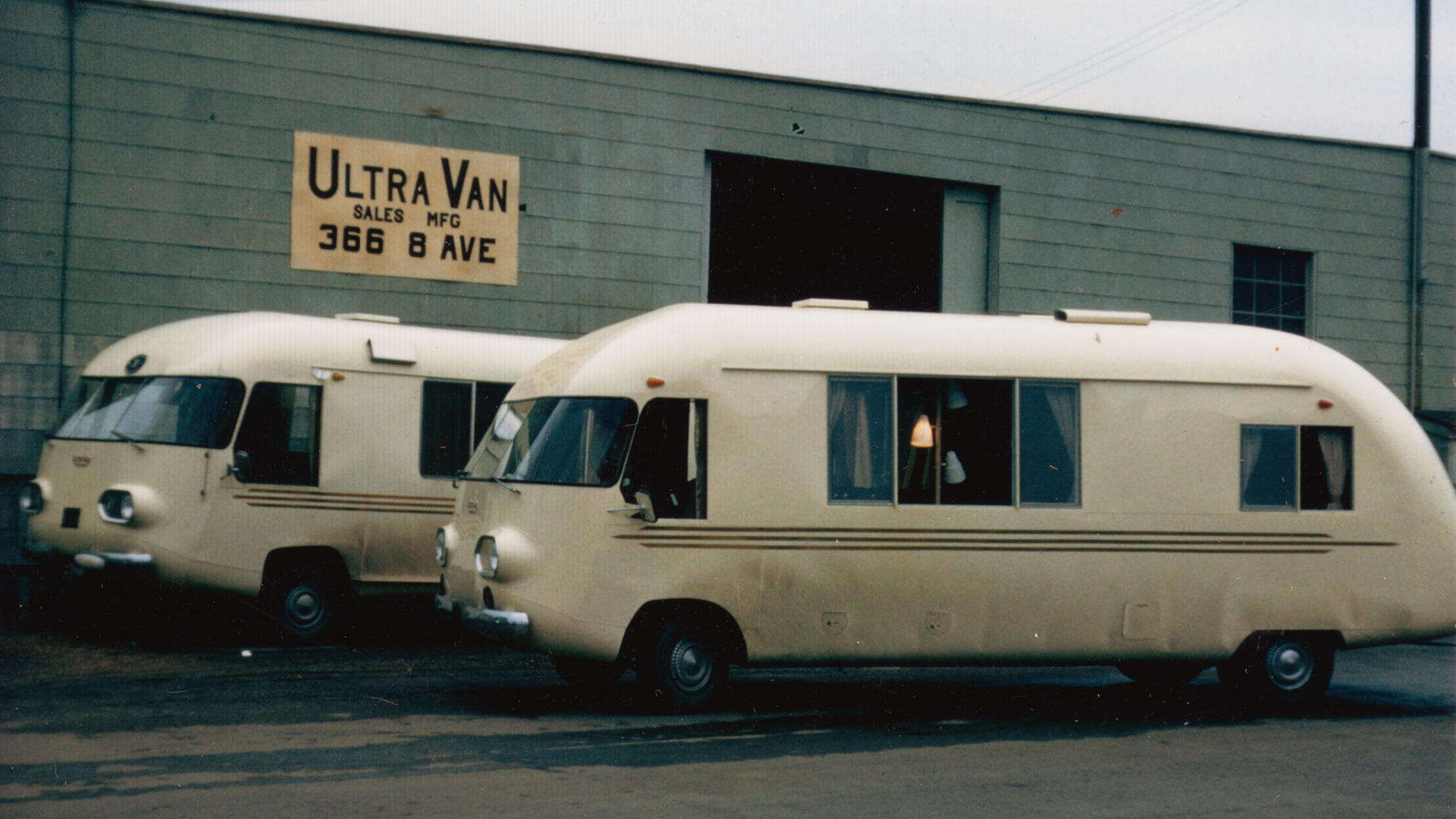
He set up shop in a wooden warehouse at 366 8th Avenue in Oakland (which he would continue to use through 1973), tacked up a full scale profile of the coach on the wall, hired some local high school & tech school students, and started building "the Demo Van" (which would later be known as UltraVan #200).

Surviving records show that on October 3 1962 Peterson demonstrated his "Go-Home" to Ed Cole at the the GM engineering center in Detroit; in mid-November 1962 the Go-Home flyer (featuring a photo of the completed Demo Van) went to press in the 1963 Chevrolet Silver Book; on February 1-10 1963 the coach itself was displayed to the public at the 19th annual San Francisco National Sports and Boat Show (at the Cow Palace); and on March 30-31 1963 it was displayed at Montgomery Chevrolet in North Hollywood. The coach was last registered as a 1963 model.

The new design carried over the prototype's 24 foot length, Corvair drivetrain & swing-arm rear suspension, stepvan windshields, Chevy pickup bumpers, front and rear tow hitches, ornamental dually wheels, and Spartan trailer rear body shape; however the reverse-tumblehome side profile was abandoned in favor of a more conventional shape.

The new coach sported Ford Econoline headlights, Ford Falcon taillights, and a new full-width front suspension incorporating very large control arms. Unique features of #200 include the shape of the front wheel arches and the wedge-shaped rocker panel trim. The left side molding was actually used as an external wiring harness gangway. Peterson reported that the completed Demo Van weighed 1,815 lbs empty and 2,710 lbs with all furnishings.

Pictures show #200 parked alongside the Oakland shop as late as 1965 (partially hidden behind #203), and it is most likely that Peterson personally operated it until he acquired #302 in 1967. The next three owners listed in the Club archives are: Harold N. Zastrow of Linthicum Heights MD (the date 3/23/67 is noted but not explained), Oren E. Hines of White Marsh MD, and Henry & Pauline Wills of Savage MD (who were UltraVan Club members from 1973-74).

In 1975 Mel Dinesen of Bakersfield California retrieved the coach from Florida, then completely gutted and rebuilt the interior, swapped in a 110 hp engine, converted the rear suspension to the later Ultra, Inc. trailing arm design, changed out the large galley window, and added a window to the door and a solar panel to the roof. Mel and his wife Millie showed the coach at Corvair shows and UltraVan rallies on the west coast for over twenty years.

#200 was acquired by a prominent performance artist in 1998. Rirkrit Tiravanija intended to drive the coach across the USA with five Thai art students as an art project sponsored by the Philadelphia Museum: "Untitled 1998 (on the road with Jiew Jeaw Jieb Sri and Moo)":
http://www.philamuseum.org/exhibitions/1998/7.html
A book/CD-ROM/Exhibition Catalog was published in conjunction with the project.

Unfortunately the coach was wrecked early in the project, but after its completion Tiravanija retrieved the coach from Arizona and displayed part of it in his exhibition "Untitled 1999 (reading from right to left)" at the Wexner Center For The Arts in Columbus Ohio (Jan-Apr 1999). It is not known what became of the remains of the coach after the show.

A collection of photos of the Demo Van can be seen here:
https://www.flickr.com/photos/8769347@N03/sets/72157650166747825

Sunday, August 16, 2020

The First UltraVan

On September 1 1960, Dave Peterson started construction of the first UltraVan in a rented garage in Alameda California. Four months later on January 2 1961, Peterson drove his creation to the Department of Motor Vehicles and received a license for his "1960 housecar".


The 24 foot long coach was designed around the remains of a wrecked 1960 Corvair sedan; incorporating the 80 horsepower engine, two speed Powerglide automatic transmission, front and rear suspension, headlights, tail lights, and instrument panel. The windshields were sourced from a Chevrolet stepvan, the bumpers from a '47-55 Chevy pickup, and most everything else was hand built from riveted aluminum and fiberglass by Peterson himself.

For maximum living space, the coach was a full 8 feet (96 inches) wide at the top. To work with the suspension from the 67 inch wide car Peterson developed a unique reverse-tumblehome body shape that narrowed the body to just 86 inches inches at the bottom. Then he cut out the car's front suspension crossmember, moved the two remaining assemblies apart, and riveted them to the coach structure. In the rear he added ornamental dually rear wheels to fill out the wheel wells. To insure the dually wheels wouldn't overload the car's suspension he kept them at a very low air pressure.


The rear body was shaped to resemble Peterson's beloved Spartan travel trailer. Remarkably, both fiberglass rear corner panels were created using the same mold, but one of the panels was flipped inside out when the resin was partially cured. Two tow hitches were installed - one on the rear to tow his 1958 Dorsett Catalina, and a second on the front to launch and recover the boat.

Without any interior furnishings the revolutionary coach weighed less than 1,800 lbs empty - "Five times the cube of the VW Van and 400 lbs lighter", or "one-half the weight of a Greenbrier and over twice the space." Even after the finished interior was installed it still weighed under 3,000 lbs.

Peterson (David G.) and his son (David L.) operated the coach until at least 1973, at some point modifying the side windows to more closely resemble the production UltraVans. Then for one and a half dozen years the coach passed out of all knowledge into history and legend. Eventually rumors of an unusual UltraVan came to Jim Craig via his friend Mory Snyder, and together they tracked down the prototype rotting away in a grape field near Oroville, California.

Recovery was accomplished by April 1990, and a Club restoration project was organized with many donations of time, labor, parts, and even cash. By 2001 interest had waned; only one couple showed up to the final Restoration Rally. In 2003 the coach found a new home at the Lane Motor Museum in Nashville Tennessee (profits from the sale were returned to the Club). Lane displayed the coach until early 2014, when it was purchased by Craig & Lea Lamond and driven to Portland Oregon. The Lamonds plan to return the prototype UltraVan to its original configuration.

A collection of photos of the Prototype can be seen here::
https://www.flickr.com/photos/8769347@N03/sets/72157644794709346/

April 1990 discovery and recovery:
http://imgur.com/a/dUqUt

April 1994 Restoration Rally:
http://imgur.com/a/87mvG

November 1994 Restoration Rally:
http://imgur.com/a/UQRyc

May 1995 Restoration Rally:
http://imgur.com/a/A3jtX

More restoration photos:
http://imgur.com/a/zJ2pX