Sunday, November 8, 2020

The Fifteenth UltraVan

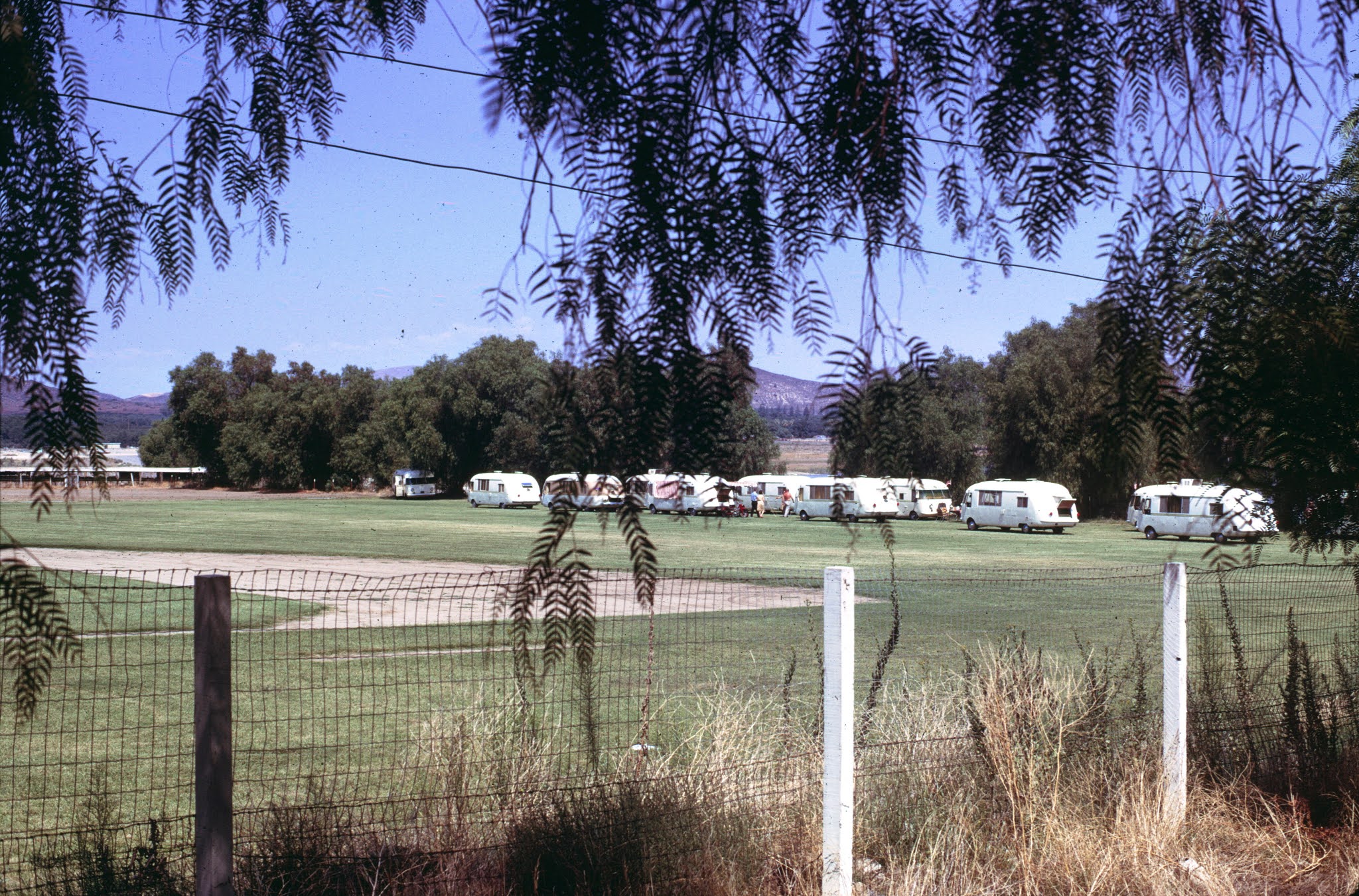
September 1968, Lake Elsinore CA
Records of the 1965 Oakland UltraVans (serial #203-210) are even more jumbled than the Travalon records:
-Dave Peterson's customer records show three owners of #15 and one of #204 (which should be the same coach).
-When Jim Craig bought #206 he found out it was the same coach that Pete Dodge had listed as #65 (similar to when Jim bought William Lane's #13 and found out it was actually serial #202).
-Customer records show one owner of #18 and two of #207 (and both numbers were listed with different owners in the 1969 roster).
-Vernon Sandel listed his 27 foot long coach as #108 for 4 years and then 208, 108, 208 for the next three (it does not have a 1st generation front end so it can't be #108).
-Hurd's #20 (serial #209) is not the same vehicle as Darwin's #209 (though both had leading-arm rear suspension).

September 1968, Lake Elsinore CA
In addition, almost all of these coaches have disappeared with hardly a trace.
#15/204 hasn't been identified since 1973.
#17/65/206 was stolen sometime between 2001 and 2011, and never recovered.
#18/207 hasn't been identified since 1973.
#19/208 (the 27 footer) was last seen in 2007 near the Salton Sea.
#209 hasn't been identified since around 2000 (but #20 was at the 2019 Ultra Week in Kearney).
#210 was last seen in a Santa Ana CA used car lot in the mid-1980s.

As a result, the only confirmed information we have for #15/204 is the names of five owners:
#15 was delivered to Judge Charles Bruce of Atlanta GA.
#15 was owned by C. M. "Mel" Winter of Winter Welding and Machine Corp in York PA.
#15 was owned in 1969 by John H. Jr. & Carmen F. Morris of Palm Springs CA (who joined the UVMCC for one year).
#15 was bought from Morris by Leon G. Paquett of Seattle WA.
#204 was owned by Frank Cheney of Waldorf MD sometime prior to 6/19/73.

September 1968, Lake Elsinore CA
When Mel Winter met Norm Helmkay at the famous Hershey swapmeet, Mel said he had owned the only 26 foot long UltraVan, but we don't know if he meant #15/204 was stretched, or if he also owned #19/208 (the 27 footer) at some point, or if there is some other explanation. For whatever it is worth, Dave Peterson never mentioned building any other stretched Ultravan besides #208, so it seems unlikely that #204 was 26 feet long.

In Christy Barden's 1992 "First 24 UltraVans" article, he states that #204 was a 22 foot coach with a modified late model Corvair suspension. The source of that information is not recorded.

Another possibility to consider is whether Victor "Jack" & Ethel Darwin of Carlsbad CA could have misidentified their coach #209 when they joined the Club in 1972. It isn't hard to imagine the DMV transposing the serial number 204 into 209...

(Photos from the September 1968 rally on the parade grounds of Lake Elsinore Military Academy, Lake Elsinore CA)

Sunday, November 1, 2020

The Fourteenth UltraVan

UltraVan #203 is the last of the first generation of UltraVans - with the extended A-pillar member that defines the front corner of the coach, the chrome Chevy pickup bumpers, the swing-arm rear suspension, and the ornamental dually wheels. It is also the last coach with the stove installed on the left side of the galley.

At 22 or 23 feet long, #203 first appears to be a dead ringer for #6, until you start to notice the details: the squared-off rear window corners, the wedding-cake taillights, the lack of tow hitches and cooling air intakes, and the distinctive front wheel arches.

Also, the front overhang is a little bit shorter on #203. The front edge of the wheel well lines up with the top corner of the windshield on #6, but with the lower corner of the windshield on #203 - which is consistent with the later 22 foot UltraVans. Although the front window still appears to be a bit wider than the later ones, it is visibly narrower than #6's front window.

This is the first UltraVan where the Ford Econoline headlight bezels were not modified to incorporate the turn signals - instead the turn signals are mounted in the body just below the headlights. This is also the only coach (other than the prototype) where the fiberglass front roof corners are separated by an aluminum section with support ribs underneath.

Even though #203 was built in Oakland, it has anachronistic "UltraVan - Hutchinson, Kans" emblems installed front and back. It is currently registered as a 1965 model.

Dave Peterson's notes tell us that the fourteenth UltraVan was initially delivered to Robert V. McAninch of Jupiter Auto Sales (Jupiter FL). Huston & Maida Hurt of Redding CA registered coach #203 with the UVMCC from 1968 to 1973, and Richard & Retta Kossow of Ojai CA registered it with the Club from 1985-2002. Retta served as juror on the trial of the four policemen accused of using excessive force against Rodney King in 1992. Richard passed away in 2001.

Michael LaRoche of Ventura CA bought the coach in 2005, and found that it had not had a valid registration "since the early eighties". In 2008, he sold the coach for $200 to the current owner Aaron Landy of Los Angeles CA. Aaron joined the Club from 2009-2012. 

Aaron had to replace the blown/warped 140 hp engine with a rebuilt 110 hp engine to get the coach back on the road. Over the years he has also made structural repairs, replaced the windshields, fixed several issues with the steering, and thoroughly insulated the coach with polyisocyanurate board (secured with expanding foam gap filler and reflectix tape).

The coach lives on the street in west Los Angeles, and random strangers wandering past frequently post pictures of it on Instagram. 


Sunday, October 25, 2020

The Thirteenth UltraVan

The thirteenth UltraVan was built in late 1964 for William & Grace Lane of Pico Rivera CA. Assigned serial #202, this coach is both transitional and utterly unique.

Previous coaches had a diagonal side frame that followed the windshield shape and established the rear edge of the front corner panel. With #202 Peterson shortened the forward body, truncated the diagonal frame, and developed a new fiberglass corner panel that wrapped back to the vertical frame at the front of the wheel well. This resulted in the first 22 foot long coach, with its distinctive narrow slider window shape.

#202 was also the first to use ethafoam bumpers cemented directly to the body, with the now-standard Bargman "wedding cake" taillights installed above the rear bumper and small backup lights installed below. Like #201, the taillights were mounted lower than what would eventually become standard with coaches after #206. This was the last coach with the front turn signals mounted inside the Ford Econoline headlight bezels.

Removable holding tanks were installed beneath the floor, made of riveted aluminum and lined with sealant to prevent leaks. The 1964 "camber compensator" rear suspension was used, with the new 110 hp engine and 13" ornamental dually wheels. Weighing in at 2,875 lbs (with 5 gallons of gas), #202 was also an exceptionally light weight coach and acceleration with the stroked-out engine was brisk.

A unique new configuration was developed at the Lanes' request, with the galley installed directly behind the passenger seat and the entry door moved rearward. A slightly taller refrigerator was used, with the usual drawer above it reduced to a sliding counter extension.

The galley was arranged with the stove on the left (next to the passenger seat) and the refrigerator on the right (next to the entry door). Note that the stove had also been installed to the left in #101, #200, #103, #63104, and #201, but was on the right in #104, #163102 and #264105.

The usual molded fiberglass canopy above the front seats was omitted, but upper cabinets were built into both sides of the cockpit. The front wheel well on the driver side received an extension to support the bench seat, but the passenger side did not. A wall furnace was installed on the front bathroom wall next to the entry door.

William and Grace became charter members of the UVMCC in 1967, having moved to Baldwin Park. They registered their coach with the Club as #13, moved to Pacoima in 1970, and let their membership expire after 1971. The sealant lining the inside of the fuel tank started crumbling and clogging the carburetors, and William wasn't able to resolve the issue.

He parked the coach with about 37,500 miles on the odometer, then in February 1987 Jim Craig bypassed the fuel tank with a 5 gallon gas can and drove it home to San Diego with no further problems. Jim and Marlene put another 12,500 miles on the coach in under 2 years, and after moving to Joshua Tree in 1988 they offered the coach for sale at $6,995, later reduced to $5,495.

Donald Gilbert of Midland TX bought the coach in December 1988, offering it for sale again at $5,250 in 1990, although by mid-1991 the asking price had been reduced to $3,500. Richard K. Morrison of La Luz NM owned the coach next, and although he let his Club membership expire in 1996, the coach remained in his family until Ken Morrison of Fort Collins CO sold it in 2011.

By this time the driver side seat pedestal extension appears to have been removed, the unique dual bullet-style front turn signals replaced, and a steel tube front bumper and towbar arrangement installed. The coach was damaged during the delivery to the San Antonio TX buyer, and its current condition, location, and owner is unknown.

Sunday, October 18, 2020

The Twelfth UltraVan

On that day, 3 weeks after my birth, when Ray Page laid off the Motor Coach Division employees, told them to pick up their final paychecks at Prescolite headquarters in San Leandro, and locked up the old wooden warehouse at 366 8th Avenue for the last time, there was one partially constructed coach left derelict on the shop floor.

But Dave Peterson retained the rights to his design, and his tooling, and his lease; and this remnant of the first failed attempt at production would soon become a springboard for Dave's new vision. He wasted little time rebooting his dream, placing a new advertisement in the June 1964 issue of Family Motor Coaching magazine, and restarting production.

The twelfth UltraVan was the last 24 foot long coach built in Oakland. In most ways it was a throwback to the coaches that preceded Prescolite's innovations, with built-up front body corners, split Chevy Pickup bumpers, Ford Econoline headlights, 13 inch ornamental dually wheels, and a 1963 Corvair drivetrain with 102 horsepower engine.

The front slider window profile was returned to the original position below the beltline, but the sheet metal camouflaging the the upper corners of the bedroom windows was gone for good. The kitchen window was lowered back down to the beltline as well, although this would change once again a few years later.

Two major innovations were introduced that would set the standard for the next seven years. A new taillight configuration was developed with large round fixtures faired vertically into the rear corners, using Trail-Lite/Bargman no. 98 "wedding cake" lenses. And a new serial numbering scheme was introduced, starting with #201.

UltraVan #201 passed through its first three owners rather quickly. It was originally sold in 1964 to Courtney Q. Nelson of Chattanooga TN. He sold to Lloyd L. Hamilton of Miami Springs FL, who bought #456 new in February 1969 and subsequently listed #201 in the 4/21/69 Miami Herald at $5,900. James I. Minix of Homestead FL was the third owner, selling to Albert Austin of Brookville FL for $2,500.

Albert & his wife Elinor owned the coach for at least twenty years, 1973-1993 - though it wasn't until 1977 that they joined the UVMCC. Eventually Albert passed away and Elinor listed the coach in the 9/19/92 Tampa Bay Times for $3,000. Bob & Rachelle Ennis of Soddy-Daisy TN became the fifth owners in 1994, selling to the current owners Jim & Ann Guider of Chattanooga TN in 1996.

Jim & Ann have since moved to Rossville GA, replaced the tired 102 hp engine with a refreshed 110 hp engine, and gradually stripped the faded and chalky paint from the coach. They often use the coach in parades and as a support vehicle for their local Corvair club. 

Note: Top photo from 1967 courtesy of John and Kathy Acosta.

A small collection of photos of #201 can be seen here:
https://www.flickr.com/photos/8769347@N03/albums/72157716509475133

Sunday, October 11, 2020

The Eleventh UltraVan

The Travalon era ended with a flourish. The Prescolite Motor Coach Division had endured through the assassination of the American President in November, but as 1963 faded in the rearview mirror, hubris was about to bite them in the ass.

The final Travalon, serial #264105, was both a clear extension of the design language that had evolved throughout 1963, and a radical new direction.

The new Custom Trim interior incorporated the Green Machine's improved bath and more formal dash panel, but instead of the sofa under the picture window it featured #63104's long "bookcase" cabinet - with an interesting two-section folding table.

Outside, the cockpit window profile and raised kitchen window from #163102 & #163103 made a comeback. And the beltline accent trim and simple two-tone paint scheme from the latter coach did as well, this time with cast Travalon emblems front and rear.

The earlier molded front corner panel concept was taken a large step further, with what appears to be a fully-molded one-piece front lower body. The new section extended all the way back to the wheel wells, with a jutting underbite profile that changed the whole look of the coach. Separate round trim rings for the headlights and turn signals were used, and a new fabricated aluminum bumper was faired into the body.

The molded section above the windshield was reshaped (although the interior molded canopy over the front seats didn't change), and a squared-off rear end with a prominent beltline ridge, new round taillights and reverse lights, and the same bumper as in front finished out the new look. For the first time, the upper rear corners of the bedroom windows were not camouflaged by rounded sheet metal corners.

Though the wheelbase appears to be unchanged from the 24 footers, the modified body sections result in a 25 1/2 foot long coach. A louvered panel is visible in the right rear corner, probably to provide cooling air for the 102 HP Corvair engine.

Plans were made, deluxe brochures were printed, press releases were issued, and the new squarebody Travalon was unveiled at the 20th annual San Francisco National Sports and Boat Show, January 31 thru February 9, 1964 (at the Cow Palace). Presumably the brochures were distributed at the show, but the only known surviving copy is the one saved (and scanned) by supervisor Ray Page.

In the days following the Show, the atmosphere around the shop changed. Page remembers "some of the tooling was being destroyed and I believe Dave was having "words" with Jones and Schaffer." Robert Wollard recalls hearing scuttlebutt that "Dave's design was a mess and that they had essentially reinvented the whole thing so that soon they would be able to ease him out of the picture and it would be theirs."

If the new body shape was indeed an attempt to stop paying Peterson's licensing fees, they hadn't counted on the fact that Dave was simply never the type of man to accept such a threat without pushing back. In any case, the Prescolite Motor Coach Division ceased operation on February 27 1964, and the employees were all dismissed.

12 months later (March 1965), the last Travalon was advertised for sale at $9,000 by James Pearson in the Santa Cruz Sentinel, and then again in May in the Sacramento Bee. Another 12 months passed and the coach (now with 4,000 miles) was listed for sale again by an unnamed individual in the San Francisco Examiner. (May 1966).

The squarebody Travalon eventually ended up in the hands of a wheelchair-bound Korean war Army veteran and Justice of the Peace in Shelby Montana named James Clinton Farrar. Jamie consulted with Peterson in November 1975, wanting to convert the coach to the side-engine configuration developed for the 600 series coaches in 1971. An odd fire 90 degree Buick V6 engine was installed, along with new windshields and a fresh paint job.

Farrar listed the coach for sale in the 1991 Whales on Wheels newsletter but didn't find a buyer. Walt Davison #366 visited on one of his cross country rambles and took the attached color photos. He went back a few years later and found that Farrar had passed away in 1994. He tried to find out what happened to the coach, but was told that the engine had been removed and the remainder hauled away to the landfill.

The 1964 Travalon by Prescolite brochure can be seen here:

Sunday, October 4, 2020

The Tenth UltraVan

The penultimate Travalon was likely the coach noted by Peterson in the Historical Record as "Seattle Lighting Display". This would make it the first UltraVan to be licensed outside of California.

Though very little is directly known about this coach, since both it and the Green Machine (serial #163102) were identified in some UVMCC records as #163 and in others as #102/103, we can infer that the tenth UltraVan was built in 1963 as serial #163103.

Travalon #163103 was a virtual twin to the Green Machine (24 feet long, stepvan windshields, Chevy pickup bumpers, Econoline headlights, Prescolite taillight pods, 13" ornamental dually wheels, raised front slider windows, molded front corners), though with a more sedate color scheme and the addition of a rear tow hitch, a roof-mounted split air-conditioner, and a small porch light next to the door.

#163103 also featured a unique beltline accent trim and a square jalousie window in the entry door. This was the first UltraVan with a window in the door, a feature that wouldn't be seen again until 1966.

A Travalon identification plate was installed next to the entry door and "ULTRAVAN - OAKLAND, CALIF" badges were installed on the front and rear. No photos of the interior survive, but the Custom Trim sticker implies an interior similar to #163102. 

This is the coach that appears with Jerry Light's UltraVan #6 in the July 1964 photo taken at Pumpkin Center SD; we don't know who the owners were at that time. The coach was registered with the UVMCC from 1985 to 1992 by Edwin & Pauline Wooldridge. The Wooldridges lived full-time in the coach in Seattle WA in 1977, but in 1981 they moved to a property alongside I-5 in Ridgefield WA.

Forrest Gist (#413) visited them there in 1997 and took the last surviving photos of the coach. Though the paint was badly faded by then, the coach was still operational. Unfortunately, in 2001 a grass fire started by teenagers smoking next to the I-5 overpass completely destroyed the coach.

A collection of photos of #163103 can be seen here: https://www.flickr.com/photos/8769347@N03/albums/72157657883871283


Sunday, September 27, 2020

The Ninth UltraVan

There are no clues in the historical record relating any known coach to build #7 or build #8. We are left to draw the tenuous conclusion that these are the two missing Travalons that have never been identified.

For coach #9 however, we find a single clue in The Historical Record - the nascent coach registry published in January 1987 by Ultra Historian Louis Griggs. Louis lists the owners of coach #009 as: Venable of CA, Farnsworth of Boise ID, and Barr Musser of Salt Lake City UT.

William R. Venable of San Carlos CA is listed in Dave Peterson's notes. Farnsworth is not mentioned in any other available records; presumably he was identified as the previous owner by Barr Musser. Barr and Thelma Musser were UVMCC members from 1975 to 1992. They initially registered as owners of coach #163, then 10 years later switched to #102. But they only ever owned one coach: serial #163102 - usually known as UltraVan #163, or rarely as Travalon #102, or more simply as The Green Machine.

The Green Machine is 24 feet long (162 inch wheelbase) with stepvan windshields, Chevy pickup bumpers, Econoline headlights, Prescolite taillight pods, and ornamental dually wheels. And although it currently operates with 14-inch wheels, the earliest photos show the same turbine 13-inch wheelcovers used on all Oakland-built UltraVans.

Prescolite omitted the tow hitches on #163, and introduced a number of significant upgrades.

This 1963 Travalon uses the upgraded 1964 model year Corvair rear suspension, with its transverse leaf spring "camber compensator". The newly stroked 1964 engine was also used (110 HP), along with a 3:89 geared axle.

The coach features a large air vent behind the passenger rear wheel and a smaller vent on the driver side, to duct cooling air directly into the engine compartment. Although this arrangement seems familiar to most UltraVanners, it was actually not incorporated into production until after #235. For those early coaches, cooling air is drawn from below the coach around the unsealed perimeter of the engine.

Alert readers may have noticed that #6 also was equipped with external cooling air vents, though they are located further aft. #101, #200, #103, #4, & #63104 were not.

Out front, Prescolite integrated the headlight fairings, the bumper brackets, and the previously separate aluminum and fiberglass body sections into two large molded sections - one for each corner. They also altered the front slider windows, raising the bottom edge to align with the rear windows along the beltline.

Inside, Custom Trim installed their usual upholstered walls and ceiling, and added a Pullman-style folding sink to the bathroom for more comfortable showering.

Perhaps most significantly, Prescolite installed three removable fiberglass holding tanks under the floor of the coach (fuel, water, & waste). Earlier coaches created tankage by simply sealing up portions of the riveted aluminum floor structure, which eventually resulted in extremely difficult to repair corrosion problems and leaks.

To create space for the removable tanks, Prescolite used extruded rocker beams with cast aluminum fittings connecting to front and rear cross beams. The cast corner fittings cleverly incorporate sockets for removable jacking points.

With its two-tone lime & forest green paint scheme and elaborate white striping, the Green Machine definitely stands out in a crowd. Barr & Thelma attended UltraRallies throughout 1975-1979, including Robert's Creek British Columbia, Lake Cahuilla CA, Russian River (Guerneville) CA, and Walla Walla WA. In 1988 Barr listed the coach for sale in the Whales on Wheels newsletter, but he wasn't able to find a buyer. Finally in 1992 he donated the coach to Jim Craig, even paying to fly him to Salt Lake so he could fetch it back to Joshua Tree.

Jim soon realized why the coach hadn't sold, but with the help of local Corvairist Rudy Schmidt he was able to replace 4 bad lifters, 6 bent pushrods, the #3 rod & piston, both heads, gaskets, fuel pump, generator, and U-joint seals. They installed two rebuilt carburetors, performed a major tune-up, and bypassed the fuel feed into two five-gallon jerry cans. The 650 mile drive home to Joshua Tree was uneventful.

Jim and his wife Marlene had owned at least seven other UltraVans prior to the Green Machine, but they were quickly smitten and decided it would become their "final" UltraVan. Back in Barr's day #163 had an UltraVan emblem on the front, and a front mounted spare tire emblazoned "Barr-Thel's Happy Daze". Jim removed these and today the Green Machine has a single Travalon emblem on the trunk lid. Jim also replaced the damaged body panel under the driver's window (note the slightly darker paint), rebuilt the entire aluminum rear support structure, installed a rebuilt 140 HP engine and Corvair engine seals, changed to a 3:55 geared axle, upgraded the house and engine wiring, installed a retractible awning, and added a third roof vent in the bedroom area.

Jim & Marlene greatly enjoyed their time with the Green Machine; to this day Jim calls it the best handling UltraVan he ever drove (except for the brakes). However in 1999 the last UltraVan ever completed became available and well, Jim couldn't resist. He sold #163 to his son Robert to finance the purchase of #604. Robert Craig sold his previous coach #285 and moved the personalized "FRMMARS" plates to #163, but then he sold #163 on to Todd Koons of Sausalito CA for use in a nationwide advertising campaign. That didn't materialize and and Robert (now in San Rafael CA) bought the coach back in 2001. In April 2003 Robert used the coach to attend the Western Spring UltraVan rally at the Corvair/Camaro meet in Rancho Cordova CA, and in August 2003 the Burning Man event near Black Rock City NV. Then in July 2004, Robert sold the coach to its present owner, Brian Goldin of Redlands CA.

Because of modern fuel formulations containing ethanol, Brian eventually had to swap out the fiberglass fuel tank with a stainless steel unit he purchased from Eric Kirven (UV 345, 383, & 504). With the help of Michael Moreno (UV 257) he replaced the immense headliner, and he also removed the awning, rebuilt the engine, and upgraded to a modern on-demand water heater and a 12 volt compressor refrigerator.

Brian uses the coach regularly for relaxing getaways all over the Southern California region. He recently started considering whether it might be time to refresh the 57 year old paint.
The Green Machine has its own Facebook page: https://www.facebook.com/FrmMars

And its own dedicated Instagram hashtag: https://www.instagram.com/explore/tags/frmmars

A small collection of photos of #163102 can be seen here: https://www.flickr.com/photos/8769347@N03/albums/72157716131052663